
An enquiry sits in an inbox. A useful article stays in drafts. A cancelled appointment leaves a gap. None of these problems needs a futuristic answer. They need a reliable next step.
That is a useful way to think about AI in business: assistance with work that already has a clear purpose. Recent Australian research, established software products and business-owner discussions offer three signals about where to begin.
The first wins are familiar.
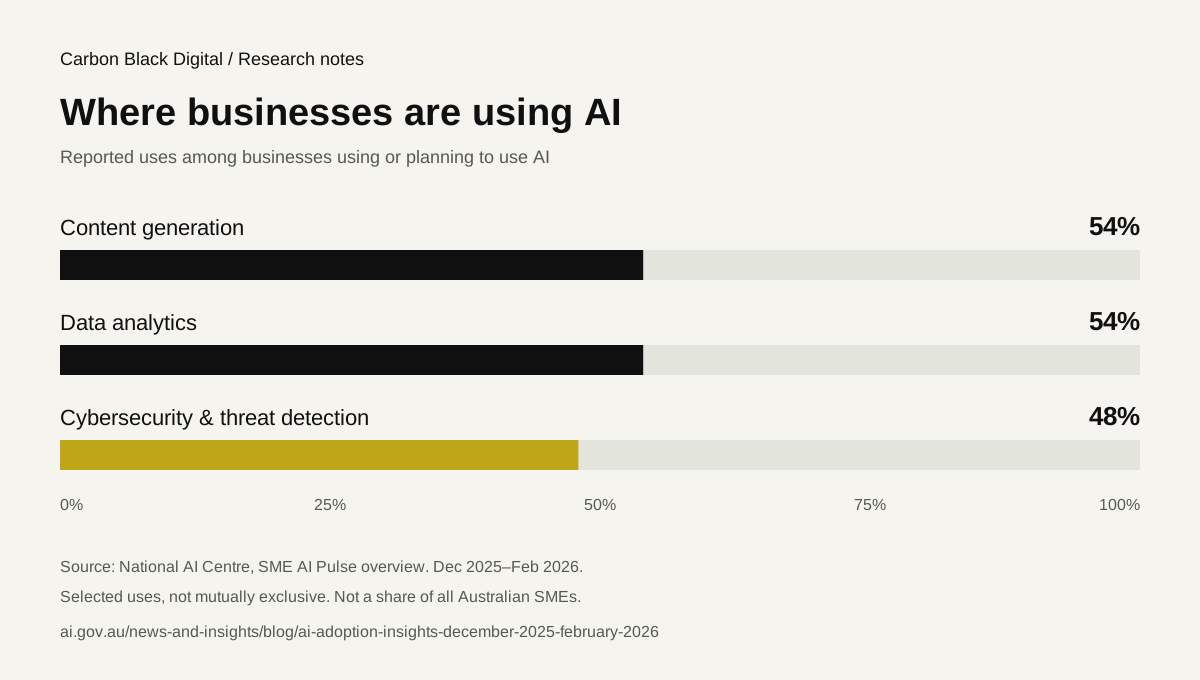
The National AI Centre reports that 43% of Australian SMEs used AI to some extent across December 2025–February 2026. Its overview lists content generation and data analytics at 54% each, and cybersecurity/threat detection at 48%, among businesses using or planning to use AI. [1]
Where businesses are using AI
Reported uses among businesses using or planning to use AI, not all Australian SMEs.
For an owner, the practical lesson is to begin with a task you understand well enough to check. A first reply, a weekly summary or a structured task list gives you something concrete to review. A convincing answer is not the same as a correct answer, and a completed draft is not the same as completed work.
The useful question is not “Can AI do this?” It is “What would a good result look like, and who checks it?”
Choose a small workflow, establish how it works today and measure the change. Count time spent reviewing and correcting, not just time apparently saved.
The opportunity is often
between the tools.
Software vendors are already building around follow-through. Jobber documents quote and invoice follow-ups. Lindy describes connected assistants with scheduled routines and approval controls. These are examples of available product categories, not independent proof of business returns. [2] [3]
Business-owner discussions reveal the friction behind those features. In one Reddit thread, contributors describe useful invoice and onboarding automation, alongside social-post automation that needed too much correction. In a physiotherapy discussion, a clinician describes cancellations leaving gaps even with patients on a waitlist. [4] [5]
These are individual experiences, not a representative survey or a ranking of what sells best. Some automation discussions include self-promotion.
Our interpretation: the missing piece is often the handover. Someone must notice an event, decide what happens next and make sure it happened. AI can help interpret an unstructured email. Ordinary rules can handle a reminder or status update. The best solution may need both.
From an incoming request to a traceable result
- 01Request arrives
- 02Task prepared
- 03Person approves
- 04Action runs
- 05Result recorded
Before buying another module, check what your existing software can already do. The aim is to remove a gap, not add another place to enter the same information. Define how the workflow stops when a customer replies, what happens when a connection fails and when a person takes over.
Control is part of the product.
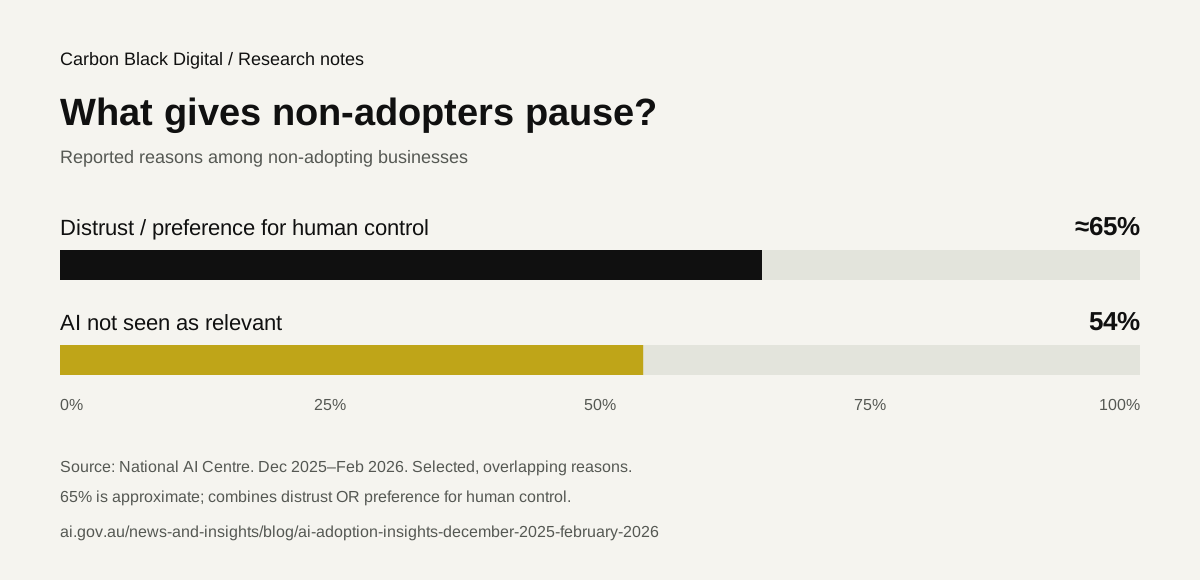
Among non-adopting businesses, the National AI Centre reports around 65% cited distrust in AI decisions or a preference for human control; 54% said AI was not relevant to their business. [1]
What gives non-adopters pause?
Reported reasons among non-adopting businesses.
We see that concern as a design brief. A useful assistant should show its sources, explain the work it proposes and make its limits visible. Sending a customer message, publishing a page or changing a financial record deserves a different level of control from preparing a draft.

Privacy needs the same attention. The OAIC advises organisations to assess AI products, their data flows and human oversight. It recommends against putting personal information, especially sensitive information, into publicly available generative AI tools. [6]
- 01Start with approved information. Keep access specific to the role and task. More access is not automatically better.
- 02Make review easy. Show the source, the proposed action and what will change.
- 03Keep a record and a fallback. Make it clear what ran, what failed and who owns the next step.
Useful work, in your business.
At Carbon Black Digital, we start with the process and the people using it. These are examples we can explore and scope with a business, not a claim that every connection or module is ready to switch on.
Inbox → Tasks
Prepare an owned task and a draft reply from an authorised business request, with the source attached.
A connected AI team member
Ask for a briefing, a document or a plan. Review the proposed work before it touches another system.
Booking recovery
Coordinate cancellation and waitlist follow-through around the practice software already in use.
Content publishing
Take a draft through editing, factual review, formatting, approval and publication.
SEO & AI search
Improve public service pages, location information and useful answers, then measure visibility and enquiries.
Search advertising
Build a bounded campaign around relevant services, an agreed budget and approved claims.
That distinction matters in marketing, too. A blog-drafting tool produces a starting point. A managed service takes responsibility for the work around that draft, from research through to publication and measurement. Neither should be confused with a guarantee of traffic or customers.
Google says established SEO fundamentals remain relevant to AI Overviews and AI Mode, without special additional technical requirements. Clear, useful public information is a sounder starting point than promises of guaranteed AI recommendations. [7]
Bring us one task
that keeps coming back.
We can map the current process, check what your existing tools already cover and scope a small, reviewable pilot. Start with the work, not a shopping list of AI features.
Talk to Carbon Black DigitalConnections, availability, data handling and scope are agreed before implementation. No guaranteed savings, search rankings or advertising results.
Sources & reading notes
Prepared 21 September 2026. The charts use a dated survey snapshot, not live September data. Figures are rounded as published. Each SME AI Pulse wave surveys at least 400 Australian SME owners/decision-makers, weighted by industry, state and size. [1]
Survey findings, vendor descriptions, Reddit anecdotes and CBD recommendations are identified separately. Illustrations are AI-generated. No client records or unpublished client results are used.
- National AI Centre — AI adoption insights: December 2025 to February 2026. First published 7 May 2026; updated 3 June 2026. Source for both charts and the 43% adoption figure.
- Jobber — Automations. Vendor documentation of product capabilities, not independent outcome research.
- Lindy — Product and plan information. Vendor description of connected assistants and approvals; plans may change.
- Reddit — Small-business automation experiences. Anecdotal discussion; not a representative sample.
- Reddit — Managing last-minute cancellations. Individual clinic experience, not Australian industry-wide evidence.
- OAIC — Privacy and commercially available AI products. General guidance; each implementation needs its own assessment.
- Google Search Central — AI features and your website. Guidance about Google Search, not every AI system.
Accessible chart data
| Use | Reported share |
|---|---|
| Content generation | 54% |
| Data analytics | 54% |
| Cybersecurity / threat detection | 48% |
| Barrier | Reported share |
|---|---|
| Distrust / preference for human control | Approximately 65% |
| AI not seen as relevant | 54% |